Frequently Asked Questions
From preparing for your appointment to understanding your results — everything you need to know about thermography at Insight Thermography & Wellness.
What should I expect when having a Thermogram?
Arrive at your scheduled appointment. After gathering a comprehensive health history, a thermogram takes less than 15 minutes for partial body images and up to 60 minutes for a full body thermogram. It is exactly like having your picture taken with a camera — 100% safe with no radiation, no contact, and no pain.
What to expect during your visit:
- Patient time for a breast scan: approx. 30 minutes; upper or full body: up to 60 minutes
- You are given time for your skin temperature to equalize with the room temperature. Rooms may feel cool as your body adjusts.
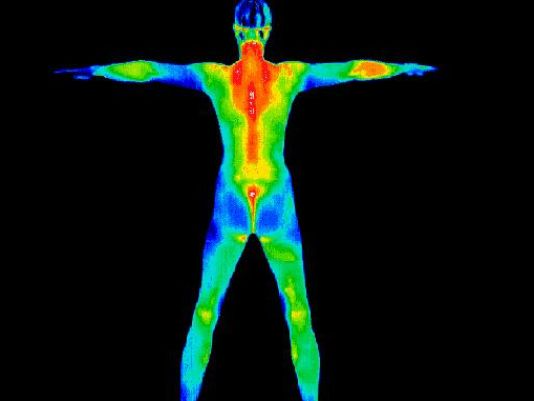
- Thermal images are taken of the whole body or just the areas under investigation
- A cervical assessment typically includes: head & neck, upper trunk & arms
- A lumbar assessment typically includes: low back, pelvis, and legs
After your appointment: Your thermogram is sent via our secure system and interpreted by board-certified Thermologists — physicians from various specialties. Normal turnaround time is 48 hours, with a rush option available. You will receive your report including images and interpretation via encrypted email. We exceed all HIPAA compliance standards and all image data is backed up daily.
Who cannot have a Thermogram?
If you have recently undergone any procedures on your breasts — such as a needle aspiration or a biopsy — or if you are currently breastfeeding, we ask that you wait 90 days before scheduling a Breast Thermogram.
What is the difference between a mammogram and a thermogram?
Mammography is an anatomical imaging test that uses low-dose X-rays to visualize the structure of the breast. It is designed to detect structural abnormalities, including very small masses and calcifications.
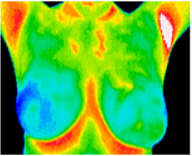
Thermography, by contrast, is a radiation-free physiological test that measures subtle temperature patterns on the skin's surface. These patterns may reflect underlying changes in blood flow, vascular activity, and inflammation that can be associated with developing pathology.
Because they evaluate different aspects of breast health, mammography and thermography serve complementary — not competing — roles. Mammography provides information about breast anatomy and structure, while thermography evaluates physiological function.
Thermography does not detect or diagnose breast cancer and cannot visualize a tumor. Instead, it identifies abnormal physiological patterns that may warrant closer evaluation or ongoing monitoring. In some cases, these physiological changes have been observed before structural abnormalities become apparent on mammography, while in other cases mammography detects abnormalities that thermography does not. Together, they provide different types of information that can contribute to a more comprehensive understanding of breast health.
Can thermography see cancer?
No — thermography does not see, detect, or diagnose cancer. It measures surface temperature and vascular patterns, which are physiological indicators, not a direct image of tissue or a tumor.
If a scan shows an area of persistent thermal asymmetry, that finding may indicate physiological changes that warrant closer evaluation — but it is not evidence of cancer and should never be treated as a diagnosis. Any area of concern should be discussed with your physician and, if appropriate, evaluated further using diagnostic tools such as mammography, ultrasound, or biopsy.
What can thermography detect besides breast cancer?
Thermography does not diagnose specific conditions, but it can reveal thermal and vascular patterns associated with a range of physiological states — including inflammation, altered blood flow, and asymmetry that may correlate with conditions such as fibromyalgia, digestive disorders, thyroid dysfunction, vascular conditions, chronic pain, and sports injuries.
These findings are meant to prompt further evaluation with your physician, not to replace it. Visit our Body Scans page to learn more about how thermography is used for whole-body wellness monitoring.
Is thermography an alternative to mammography? Do I need both?
No — thermography is not an alternative to mammography, and it should not replace it. The two tests measure different things: mammography evaluates breast anatomy and structure, while thermography evaluates physiological function, such as temperature and vascular patterns.
Because they provide different types of information, we recommend thermography be used alongside — not instead of — the mammography schedule recommended by your physician. Thermography does not detect or diagnose cancer and is not a substitute for any diagnostic breast imaging test.
Why is there debate between mammography and thermography?
The debate mirrors the larger discussion between conventional and alternative medicine approaches. Mammography is a well-established diagnostic tool in conventional medicine, while thermography offers a more preventative perspective — highlighting the importance of lifestyle and physiological changes that could lead to disease.
At Insight, we believe both have an important role. We encourage our clients to use thermography alongside — not instead of — their physician-recommended screenings.
How can thermography benefit my health monitoring strategy?
Thermography can be a helpful part of a broader health monitoring strategy by tracking physiological changes — such as temperature and vascular patterns — over time. Consistent monitoring may help you and your physician notice changes worth discussing further.
It is not a diagnostic tool and does not identify disease on its own. Think of it as one additional data point — most useful when reviewed alongside the screening your physician recommends and your overall health picture.
Who reads the images and reports?
Images are interpreted by Medical Doctors who are additionally Board Certified Thermologists — physicians from various specialties who form the team at EMI (Electronic Medical Interpretation), a subsidiary of Meditherm, all trained by the American College of Clinical Thermology (ACCT).
We use a secure HIPAA-compliant method of direct, safe transmission with these doctors. The normal turnaround time for reports is less than 72 hours, with a 24-hour rush option available for a reasonable additional fee.
Are services covered by insurance?
Unfortunately, most insurance companies do not cover thermography services as they are based on a natural and preventative approach. We recommend checking your specific insurance policy regarding thermography coverage.
What forms of payment are accepted?
We accept cash, checks, and all major credit cards including Mastercard, Visa, American Express, and Discover. Full payment is expected at the time services are rendered.
How long does each imaging session take?
Each appointment is reserved for up to 90 minutes. The actual length of your session is based on body type and the area(s) receiving imaging. Estimated times:
- Breast Imaging: 30–60 minutes
- Partial Body Imaging: 30–60 minutes
- Full Body Imaging: 60–90 minutes
- Area of Interest: 30–60 minutes
How should I prepare for a thermogram?
Main consideration: Do not do anything that will stress joints, muscles, cause you to heat up, or cause the skin surface to be blocked.
- Do not exercise, have therapies (massage, facials, physical therapy, etc.) or testing (MRI, CAT Scan, etc.) on the same day
- Do not smoke for 2 hours before the test
- Do not chew gum or drink hot beverages 2 hours before the test
- Do not use underarm deodorants, lotions, makeup, liniments, or powder on your body or face on the day of the test — they block the skin surface from registering correct temperatures. (For breast scans, face makeup is fine; just avoid applying anything to your neck area.)
- Avoid sun exposure on the day of your test
- No dietary or medication changes necessary
- You will be removing clothing down to underwear. Men, please wear briefs rather than boxer shorts for Full Body scans.
- Remove jewelry before your appointment
- Have hair off your face and away from ears and neck
- Inform your thermographer if you have had any recent skin lesions — inflammation in that area can affect the accuracy of your results
- If you have had a mammogram, biopsy, or any breast surgery within 30 days, or if you are breastfeeding, please inform your thermographer prior to testing
Will I need to submerge my hands or body parts in cool water?
No. While some older thermography methods required this practice, the advanced technology and cameras we use at Insight Thermography & Wellness eliminate this need entirely. Our modern approach ensures a comfortable, non-invasive experience — no immersion in cool water required.
Can you use a scan I received from a different thermographer for my baseline?
Yes — provided it was conducted by a thermographer within the Meditherm network. As Insight Thermography & Wellness is part of this extensive network, when your analysis is sent to our panel of doctors for review, they will already have secure access to your previous scans for reference.
This offers significant benefits for clients who have moved locations but wish to continue monitoring their health through thermography — ensuring seamless, consistent progress tracking wherever you are.
How quickly will I get my report back?
Reports are normally ready within 48 hours. We will email your report and images to you via encrypted email. If you need your report within 24 hours, an urgent fee option is available.
When you receive your report and images through email, you can easily share them with your doctors and make copies for yourself as needed.
What will I receive in my report?
Your thermogram report will contain the scan images along with a detailed written interpretation of the findings, highlighting any areas that may warrant follow-up. These reports are exclusively prepared by Medical Doctors who are Board Certified in Thermology from a range of specialties — all part of the EMI (Electronic Medical Interpretation) network of interpreting physicians.
How are images and reports delivered to me?
We will email digital copies of your reports and images directly to you and any other healthcare providers you designate — at no extra cost. Printed copies are also available upon request.
All reports exceed HIPAA compliance standards and all image data is backed up daily. As long as you are using a Meditherm provider, your reports can be retrieved for future comparison anywhere in the world.
Why do I need to come back in three months for another breast study?
The most accurate result we can produce is change over time. Before we can evaluate any changes, we need to establish an accurate and stable baseline unique to you — your thermal fingerprint.
A baseline cannot be established with only one study, because we would have no way of knowing if that initial pattern is your normal or if it is actually changing. By comparing two studies three months apart, we can judge whether your breast physiology is stable and suitable to be used as your normal baseline.
The three-month interval relates to the time it takes for blood vessels to show change. Less than three months may miss significant change; more than three months can also miss change that may have already taken place. There is no substitute for an accurate baseline — a single study cannot establish one.
How often should I receive a thermogram?
For establishing a reliable baseline, two breast thermograms are initially suggested three months apart. After the baseline is established, a yearly thermogram is recommended for most individuals to monitor for any physiological changes over time.
For those with a history of breast cancer or high risk factors, more frequent thermography may be advised. The optimal frequency should be determined in consultation with a healthcare professional who can consider your individual health needs and risk factors.
What should I do with my thermogram report findings?
If your thermogram indicates areas of concern or increased physiological activity, here's what we recommend:
- Consult Your Doctor: Share your thermogram report with your primary care physician or a specialist. They can interpret the results in context with your overall health and medical history.
- Further Testing: Depending on findings, your healthcare provider may recommend additional tests such as a mammogram, ultrasound, MRI, or biopsy.
- Follow-Up Thermography: Your doctor might recommend a follow-up thermogram after a period of time to monitor changes in thermal patterns.
- Assess Risk Factors: Discuss potential risk factors and lifestyle changes that might improve your health — including dietary changes, exercise, stress management, and avoiding environmental toxins.
- Develop a Plan: Work with your healthcare provider to develop a personalized plan to address and monitor your health based on your results.
Ready to Book Your Scan?
Insight Thermography & Wellness provides radiation-free, contact-free thermography for breast health and whole body pain or injury concerns.